
Introduction to Amazon Web Services
Amazon Web Services (AWS) is the world’s most comprehensive and broadly adopted cloud platform. Started in 2006, it allows individuals, companies, and governments to access technology services such as computing power, storage, and databases on an on-demand basis.
Instead of buying, owning, and maintaining physical data centers and servers, you can access technology services from AWS and pay only for what you use. This is akin to flipping a light switch: you pay for the electricity (compute power) when you need it, and turn it off when you don't.
Why AWS?
Amazon Web Services is the world’s most comprehensive and broadly adopted cloud, enabling customers to build almost anything they can imagine. We offer the greatest choice of innovative cloud and AI capabilities and expertise, on the most extensive global infrastructure, with industry-leading security, reliability, and performance.
The AWS Global Infrastructure
The backbone of AWS is its massive global infrastructure. Understanding this is key to architecting resilient applications.
1. Regions: A Region is a physical location in the world where AWS clusters data centers. (e.g., us-east-1 in N. Virginia or ap-south-1 in Mumbai).
Why it matters: You choose a region to optimize latency (closeness to users), minimize costs (prices vary by region), and meet data sovereignty/compliance laws.
2. Availability Zones (AZs): Each Region consists of multiple, isolated locations known as Availability Zones.
An AZ is one or more discrete data centers with redundant power, networking, and connectivity.
Why it matters: If you run your app in just one data center and it floods, your app dies. If you run it across multiple AZs, your app stays online even if one building fails.
3. Edge Locations: These are smaller data centers located in major cities worldwide, used primarily for Amazon CloudFront (CDN) to cache content closer to end-users to reduce latency.
The Shared Responsibility Model:
Security is the top priority at AWS. To maintain it, AWS operates under a Shared Responsibility Model.
Security OF the Cloud (AWS Responsibility): AWS protects the infrastructure that runs all the services offered in the AWS Cloud. This includes the hardware, software, networking, and facilities.
Security IN the Cloud (Customer Responsibility): You are responsible for your data. This includes encryption, network configuration (firewalls), identity management (IAM), and OS patching.
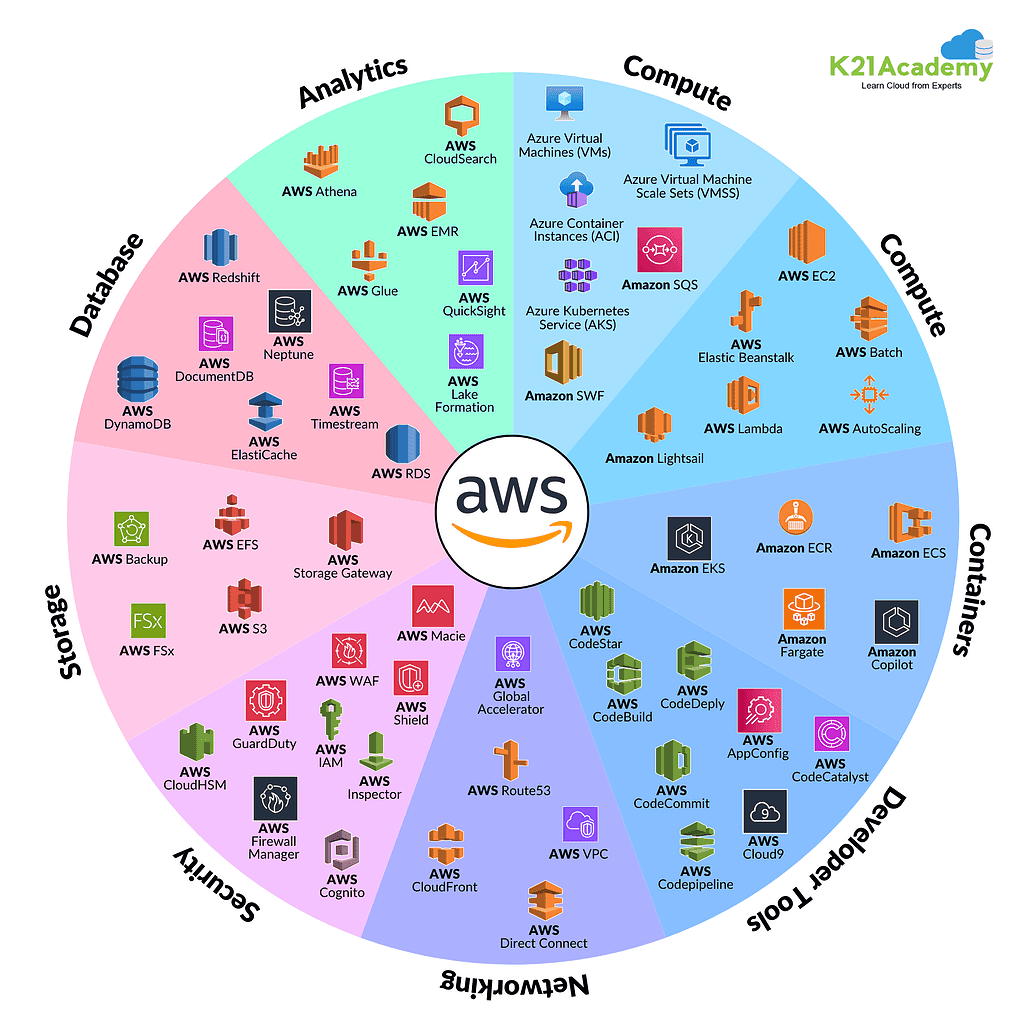
Core AWS Services
AWS offers over 200 services. Here are the fundamental ones you must know to get started.
1. Compute Services
Amazon EC2 (Elastic Compute Cloud): Resizable virtual servers. You choose the OS (Linux/Windows) and the hardware power (CPU/RAM). It is the workhorse of AWS.
AWS Lambda: Serverless compute. You upload your code, and Lambda runs it only when triggered (by an event like a file upload). You don't manage any servers.
AWS Elastic Beanstalk: Platform as a Service (PaaS) for deploying web apps. You upload code, and AWS handles the deployment (capacity provisioning, load balancing, auto-scaling).
2. Storage Services
Amazon S3 (Simple Storage Service): Object storage for files (images, videos, backups). It allows you to store and retrieve any amount of data from anywhere on the web.
Amazon EBS (Elastic Block Store): Block storage (virtual hard drives) that you attach to EC2 instances. It is persistent storage for your virtual servers.
Amazon Glacier: Extremely low-cost storage for data archiving and long-term backup.
3. Database Services
Amazon RDS (Relational Database Service): Managed SQL databases. It supports engines like MySQL, PostgreSQL, Oracle, SQL Server, and Amazon Aurora (AWS's high-performance proprietary engine).
Amazon DynamoDB: A managed NoSQL database service that provides fast and predictable performance with seamless scalability.
4. Networking Services
Amazon VPC (Virtual Private Cloud): Lets you provision a logically isolated section of the AWS Cloud where you can launch resources in a virtual network you define.
Amazon CloudFront: A Content Delivery Network (CDN) that speeds up distribution of your static and dynamic web content to users.
Amazon Route 53: A highly available and scalable cloud Domain Name System (DNS) web service.
From startups to large enterprises like Netflix, Airbnb, and NASA, AWS is widely adopted for its flexibility, scalability, and security.